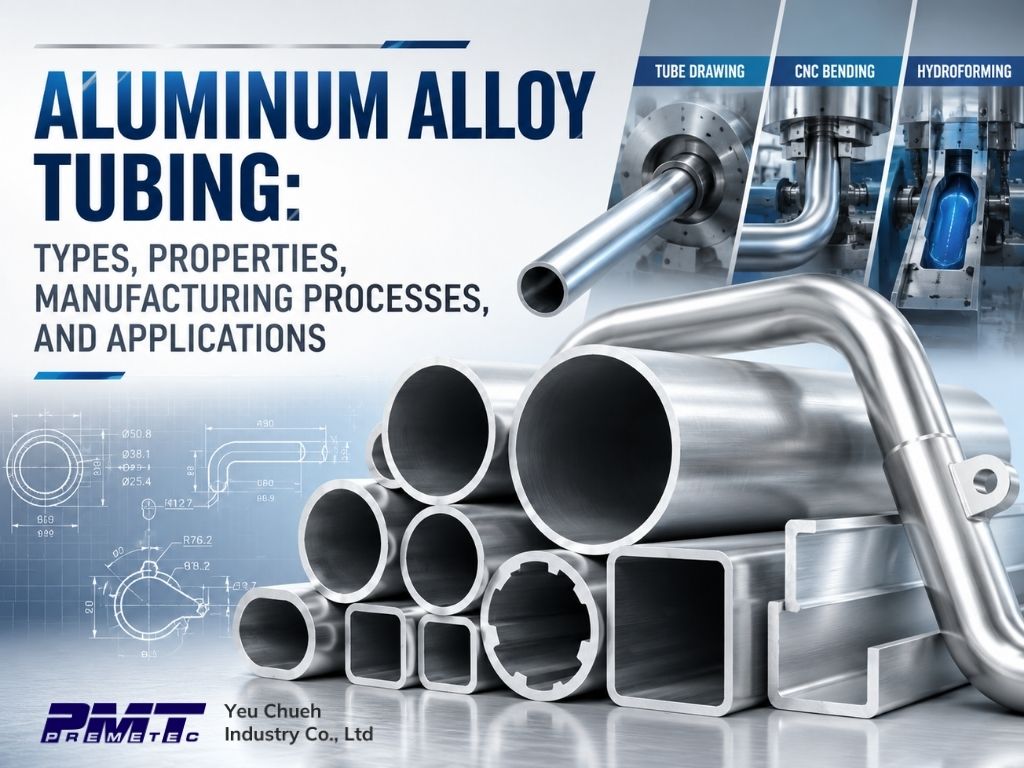
Aluminum alloy is widely used in modern manufacturing because it combines low weight, corrosion resistance, structural performance, and design flexibility. These advantages make aluminum alloy tubing suitable for bicycles, motorcycles, medical equipment, aerospace structures, unmanned aerial vehicles, and other lightweight applications.
However, the performance of an aluminum tube depends on more than the alloy grade. Wall thickness, temper, tube geometry, forming method, heat treatment, surface finishing, and quality control all affect the final component.
This guide explains the common types of aluminum alloy tubing, their main properties, manufacturing processes, applications, and the key factors buyers should consider when developing a custom OEM or ODM project.
Table of Contents
- What Is Aluminum Alloy?
- Why Is Aluminum Alloy Used for Tubing?
- Common Aluminum Alloy Series for Tubing
- Important Properties of Aluminum Alloy Tubing
- How Aluminum Alloy Tubing Is Manufactured
- Common Applications of Aluminum Alloy Tubing
- Aluminum Alloy Tubing vs. Steel Tubing
- How to Select the Right Aluminum Alloy Tube
- Information Needed for a Custom Tubing Quotation
- Working with an OEM/ODM Aluminum Tubing Manufacturer
- Frequently Asked Questions
What Is Aluminum Alloy?
Aluminum alloy is produced by combining aluminum with controlled amounts of elements such as magnesium, silicon, copper, zinc, or manganese.
These alloying elements can improve or modify properties including:
- Strength
- Corrosion resistance
- Formability
- Weldability
- Machinability
- Heat-treatment response
Aluminum alloys are generally classified by four-digit series numbers. Each series has different performance characteristics, so the correct material should be selected according to the product design, manufacturing process, operating environment, and testing requirements.
Why Is Aluminum Alloy Used for Tubing?
Aluminum alloy tubing is especially valuable in products where weight reduction and structural performance are both important.
Lightweight Construction
Aluminum has a lower density than steel. When the alloy, tube diameter, and wall thickness are properly designed, aluminum tubing can reduce component weight while maintaining the strength and stiffness needed for the application.
This is useful for:
- Bicycle and e-bike frames
- Motorcycle components
- Wheelchairs and rehabilitation equipment
- Aircraft interior structures
- UAV and drone frames
- Portable industrial products
Lower weight can improve handling, energy efficiency, portability, operating range, and user comfort.
Corrosion Resistance
Aluminum naturally forms a thin oxide layer that helps protect the material. Depending on the operating environment, additional treatments such as anodizing, coating, or polishing may further improve corrosion resistance and appearance.
Manufacturing Flexibility
Aluminum alloy tubes can be processed using methods such as:
- Tube drawing
- Diameter reduction
- Butting
- CNC bending
- Hydroforming
- Flaring
- Swaging
- Chamfering
- Threading
- Slotting
This flexibility allows manufacturers to produce tubes with different diameters, wall thicknesses, curves, cross-sections, and end features.
Common Aluminum Alloy Series for Tubing
There is no single aluminum alloy suitable for every tube. Each alloy series provides a different balance of strength, formability, corrosion resistance, and manufacturing performance.
2xxx Series
The 2xxx series mainly uses copper as an alloying element. Certain grades can provide high strength and may be considered for aerospace or performance-oriented structural applications.
However, corrosion protection, forming requirements, joining methods, and heat treatment must be carefully evaluated.
6xxx Series
The 6xxx series mainly contains magnesium and silicon. These alloys are widely used because they offer a practical balance of:
- Strength
- Corrosion resistance
- Formability
- Weldability
- Extrusion performance
- Surface-finishing quality
6061 is commonly considered for structural tubing used in transportation, bicycles, industrial products, and other lightweight structures.
7xxx Series
The 7xxx series primarily uses zinc, often combined with magnesium. Certain 7xxx alloys can provide very high strength and are used in aerospace, sports equipment, and high-performance transportation products.
Examples include 7075, 7050, 7010, and 7N01.
Although these alloys may offer higher strength, they are not automatically the best choice for every project. Formability, weldability, corrosion protection, cost, heat treatment, and production consistency must also be considered.
Important Properties of Aluminum Alloy Tubing
Strength and Stiffness
Tube performance should be evaluated according to actual loading conditions, including:
- Tension
- Compression
- Bending
- Torsion
- Impact
- Vibration
- Fatigue
A high-strength alloy may still perform poorly if the tube geometry, wall thickness, joints, or heat-affected areas are not properly designed.
Wall Thickness
Wall thickness directly affects tube weight, stiffness, durability, and forming performance.
Uniform-wall tubing is suitable for many applications, while butted or variable-wall tubing can reduce unnecessary weight by placing more material in high-stress areas.
Dimensional Accuracy
Important dimensions may include:
- Outside diameter
- Inside diameter
- Wall thickness
- Straightness
- Ovality
- Bend radius
- Bend angle
- Hole and end positions
Tolerances should reflect actual assembly requirements. Unnecessarily tight tolerances may increase cost without improving product performance.
Fatigue Performance
Many tubular products experience repeated loading rather than a single static load. Bicycle frames, motorcycle structures, wheelchairs, and aerospace components may be exposed to continuous vibration and cyclic stress.
Fatigue performance is influenced by the alloy, temper, wall transitions, surface condition, welds, forming quality, and heat treatment.
How Aluminum Alloy Tubing Is Manufactured
A custom aluminum tubing project may involve several stages.
1. Requirement Review
The manufacturer reviews the customer’s drawings, 3D models, samples, expected loads, surface requirements, and production volume.
Key questions include:
- What loads will the tube experience?
- What is the target weight?
- Will the tube be bent or hydroformed?
- How will it be assembled?
- What tests or documentation are required?
2. Material and Temper Selection
The alloy and temper are selected based on strength, formability, corrosion resistance, welding, finishing, and final performance requirements.
Some tubes may be formed in one condition and heat-treated afterward to achieve the required mechanical properties.
3. Tube Drawing and Diameter Reduction
Drawing processes are used to control tube diameter, wall thickness, and dimensional accuracy.
Multiple drawing stages may be required depending on the starting tube and the final specifications.
4. Butting
Butted tubing has different wall thicknesses along its length. Thicker sections are retained near joints or high-stress areas, while lower-stress sections are made thinner.
This process can reduce weight without removing material from critical areas.
5. CNC Bending
CNC bending creates repeatable curves and complex tube shapes.
The tooling and process parameters must control:
- Wrinkling
- Flattening
- Springback
- Wall thinning
- Surface marks
- Cross-sectional distortion
The practical bend radius depends on the alloy, temper, diameter, wall thickness, and tooling design.
6. Hydroforming
Hydroforming uses internal fluid pressure and external tooling to shape a tube into a defined profile.
It can produce:
- Non-circular sections
- Expanded areas
- Complex curves
- Larger joint interfaces
- Ergonomic profiles
- Aerodynamic shapes
Hydroforming allows engineers to create tube shapes that may be difficult to achieve through conventional bending alone.
Successful hydroforming requires coordination among material selection, tube preparation, tooling, pressure control, lubrication, and heat treatment.
7. Secondary Processing
After forming, additional processes may include:
- Flaring
- Swaging
- Chamfering
- Threading
- Slotting
- Hole machining
- End trimming
These features must match the final assembly design and tolerance requirements.
8. Heat Treatment and Surface Finishing
Heat treatment may be used to achieve the specified final properties. Stress relief may also be required after forming or machining.
Surface-finishing options may include:
- Anodizing
- Sandblasting
- Coating
- Polishing
- Customer-specified finishes
The selected finish should match the required appearance, corrosion resistance, wear resistance, and assembly method.
9. Inspection
Inspection may include:
- Dimensional measurement
- Wall-thickness verification
- Visual inspection
- Mechanical testing
- Surface inspection
- Material documentation
- Prototype testing
For safety-related applications, the inspection and validation requirements should be agreed upon before production.
Common Applications of Aluminum Alloy Tubing
Bicycle and E-Bike Components
Aluminum alloy tubing is commonly used for:
- Frame tubes
- Handlebars
- Seat posts
- Fork-related structures
- E-bike frames
These products require low weight, stiffness, fatigue resistance, forming capability, and consistent surface quality.
Motorcycle and Mobility Products
Applications may include handlebars, frame structures, control components, battery-supporting structures, and lightweight mobility frames.
These parts may be exposed to vibration, impact, torsion, and repeated road loads.
Medical and Rehabilitation Equipment
Aluminum tubes may be used in:
- Wheelchairs
- Walkers
- Adjustable beds
- Rehabilitation devices
- Medical equipment frames
- Surgical light arms
These applications often require low weight, durability, dimensional consistency, clean appearance, and easy movement.
Aerospace and UAV Applications
Possible applications include aircraft seating structures, cabin equipment frames, lightweight support structures, UAV frames, landing structures, and payload supports.
These projects may require detailed material traceability, process control, documentation, and testing.
Aluminum Alloy Tubing vs. Steel Tubing
Both aluminum and steel can be used for structural tubing.
| Factor | Aluminum Alloy Tubing | Steel or Chromoly Tubing |
|---|---|---|
| Weight | Lower density | Higher density |
| Corrosion resistance | Naturally corrosion-resistant | Usually requires added protection |
| Tube size | May use larger sections for stiffness | Can use more compact sections |
| Forming | Depends on alloy and temper | Depends on grade and heat treatment |
| Surface finishing | Suitable for anodizing and coating | Suitable for coating, plating, or painting |
| Typical advantage | Lightweight construction | Strength, toughness, and compact geometry |
The correct choice should be based on the finished component rather than raw material strength alone.
How to Select the Right Aluminum Alloy Tube
Operating Conditions
Consider loads, vibration, impact, temperature, corrosion exposure, and expected service life.
Manufacturing Requirements
Confirm whether the tube requires bending, butting, hydroforming, welding, machining, or heat treatment.
Assembly Method
The method used to join the tube to other components may influence the alloy, wall thickness, surface condition, and tolerance requirements.
Testing Requirements
Prototype testing, fatigue testing, dimensional inspection, and documentation should be planned early in the project.
Design for Manufacturing
Early communication with the tubing manufacturer can help identify impractical bend radii, difficult wall transitions, excessive tolerances, and unnecessary machining.
Information Needed for a Custom Tubing Quotation
To support an accurate evaluation, buyers should provide:
- 2D drawings or 3D models
- Preferred alloy and temper
- Tube dimensions
- Wall-thickness requirements
- Critical tolerances
- Bend angles and radii
- Hydroformed profiles
- End-forming details
- Surface finish
- Joining method
- Testing requirements
- Prototype quantity
- Annual production volume
When the alloy or process has not been finalized, the manufacturer can help recommend a practical production route.
Working with an OEM/ODM Aluminum Tubing Manufacturer
A capable OEM or ODM partner should provide more than standard tubing. Complex projects may require support in material selection, design review, prototyping, forming, heat treatment, finishing, testing, and mass-production control.
Yeu Chueh Industry Co., Ltd. specializes in custom aluminum alloy and chromoly steel tubing for lightweight and precision-demanding applications. Its capabilities include butted tubing, diameter reduction, CNC bending, hydroforming, end forming, heat treatment, stress relief, and surface finishing.
Early collaboration allows product developers to better balance material performance, manufacturing feasibility, cost, weight, and production consistency.
Frequently Asked Questions
What is the best aluminum alloy for tubing?
There is no single best alloy. The correct material depends on strength, forming, corrosion resistance, welding, heat treatment, surface finish, and operating conditions.
Is 6061 aluminum suitable for structural tubing?
6061 is commonly used because it provides a practical balance of strength, corrosion resistance, formability, and manufacturability. Its suitability must still be confirmed for the specific design.
Is 7075 stronger than 6061?
Certain 7075 tempers can provide higher strength, but 7075 may have different forming, welding, corrosion, and cost considerations.
Can aluminum alloy tubing be hydroformed?
Yes. Successful hydroforming depends on the alloy, temper, tube geometry, wall thickness, tooling, pressure control, and heat-treatment sequence.
What is double-butted tubing?
Double-butted tubing generally has thicker walls near both ends and a thinner center section, helping reduce weight while retaining material around high-stress areas.
What information is needed for a quotation?
Buyers should provide drawings, dimensions, alloy preferences, tolerances, forming requirements, surface finish, quantity, testing standards, and delivery expectations.
Develop Your Custom Aluminum Alloy Tubing Project
Selecting aluminum alloy tubing requires coordination among material properties, wall-thickness design, manufacturing processes, joining methods, surface treatments, and testing requirements.
Yeu Chueh provides OEM and ODM development support for custom aluminum alloy tubing used in bicycle, motorcycle, medical, aerospace, UAV, and other lightweight structural applications.
Contact Yeu Chueh to discuss your drawings, material requirements, prototype quantities, and mass-production plans.
