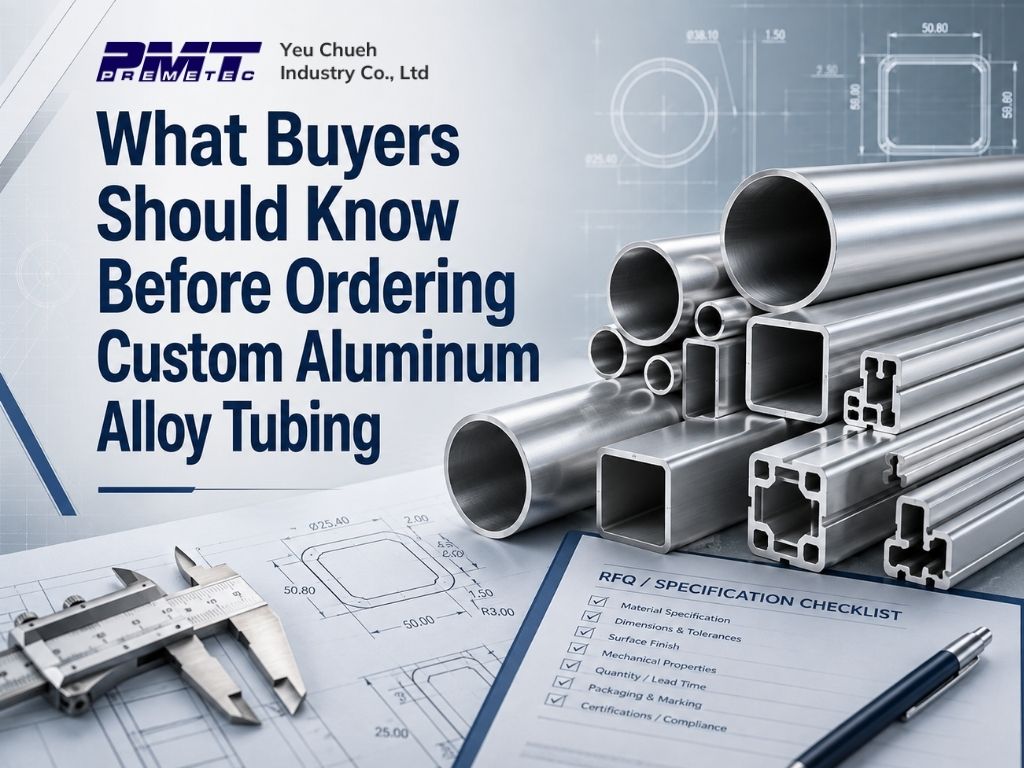
Custom aluminum alloy tubing is often required when standard tube sizes or profiles cannot fully meet a product’s structural, dimensional, weight, forming, or appearance requirements. It is widely used in bicycle frames, motorcycle components, medical equipment, aerospace structures, unmanned aerial vehicles, mobility products, and other lightweight assemblies.
However, ordering a custom tube involves more than specifying an outside diameter and length. Alloy grade, temper, wall thickness, tolerances, bend geometry, forming processes, heat treatment, surface finishing, inspection requirements, and production volume can all affect manufacturing feasibility and final performance.
Providing complete project information at the beginning allows the tubing manufacturer to evaluate the design accurately, identify possible production risks, and recommend a practical OEM or ODM manufacturing solution.
Table of Contents
- Why Custom Aluminum Alloy Tubing Requires Early Planning
- Define the Application and Operating Conditions
- Select the Appropriate Alloy and Temper
- Confirm Tube Dimensions and Wall Thickness
- Identify the Required Forming Processes
- Set Practical Dimensional Tolerances
- Consider Assembly and Joining Requirements
- Define Heat Treatment and Surface Finishing
- Plan Prototyping, Testing, and Inspection
- Confirm Order Quantity and Production Expectations
- Information to Provide When Requesting a Quotation
- Frequently Asked Questions
Why Custom Aluminum Alloy Tubing Requires Early Planning
A custom aluminum tube is usually part of a larger structural or mechanical assembly. Its performance depends not only on the raw material but also on how the tube is drawn, bent, hydroformed, heat-treated, machined, joined, finished, and loaded during use.
A design that appears simple in a 3D model may create manufacturing challenges such as:
- Excessive wall thinning
- Wrinkling during bending
- Cross-sectional distortion
- Cracking during expansion
- Difficult springback control
- Inconsistent surface appearance
- Insufficient space for tooling
- Tolerance conflicts during assembly
Early technical communication helps identify these risks before tooling or mass production begins.
For complex projects, buyers should involve the tubing manufacturer during the design stage rather than waiting until every specification has been finalized. Design-for-manufacturing feedback can simplify tooling, reduce unnecessary processing, improve production consistency, and shorten the overall development cycle.
Define the Application and Operating Conditions
The first step is clearly explaining how the aluminum alloy tube will be used.
A manufacturer cannot recommend the most suitable material or production route based on a drawing alone. The functional requirements and operating environment must also be considered.
Important information includes:
- Static and dynamic loads
- Bending or torsional forces
- Vibration and fatigue conditions
- Impact requirements
- Operating temperature
- Outdoor or corrosive exposure
- Expected product life
- Safety or regulatory requirements
- Weight limitations
- Appearance expectations
For example, a tube used as a decorative equipment cover has very different requirements from a bicycle frame tube, wheelchair structure, aircraft seating support, or UAV component.
Even when two parts have similar dimensions, their material, wall thickness, temper, testing, and inspection requirements may be completely different.
Select the Appropriate Alloy and Temper
The aluminum alloy should be selected according to the complete manufacturing and application requirements—not strength alone.
Different aluminum alloy series provide different combinations of:
- Mechanical strength
- Corrosion resistance
- Formability
- Weldability
- Machinability
- Heat-treatment response
- Surface-finishing performance
The temper designation is equally important because it describes the material condition resulting from mechanical or thermal treatment. Aluminum tubing specifications should therefore identify both the alloy and temper whenever final mechanical performance is important.
Certain 6xxx-series alloys are commonly considered when a project requires a practical balance of structural performance, corrosion resistance, forming capability, and finishing quality.
Some 2xxx- and 7xxx-series alloys may be considered for higher-strength applications, but they can involve different forming, welding, corrosion-protection, and heat-treatment requirements.
Buyers should provide a preferred alloy when one has already been specified by the engineering team. When material selection is still open, the following information can help the manufacturer recommend suitable options:
- Required mechanical properties
- Forming complexity
- Welding or joining method
- Environmental exposure
- Surface treatment
- Weight target
- Applicable standards
- Cost considerations
One alloy should not be substituted for another based only on availability or a general comparison chart. Any alternative material must be evaluated according to the completed component and its manufacturing process.
Confirm Tube Dimensions and Wall Thickness
A custom tubing drawing should clearly identify all functional dimensions.
The basic specifications normally include:
- Outside diameter
- Inside diameter
- Wall thickness
- Tube length
- Cross-sectional profile
- Straightness
- Ovality
- End geometry
For non-round tubing, the drawing should also define the width, height, corner radius, profile orientation, and any special cross-sectional features.
Wall thickness is especially important because it directly affects:
- Component weight
- Structural stiffness
- Strength
- Formability
- Bend quality
- Hydroforming performance
- Machining allowance
- Production cost
Uniform-wall tubing is suitable for many conventional components. Butted or variable-wall tubing may be considered when more material is needed around high-load areas and less material is required in lower-stress sections.
Yeu Chueh provides a range of custom tubing processes, including butting, diameter reduction, CNC bending, end forming, heat treatment, stress relief, and surface finishing.
When specifying variable wall thickness, buyers should clearly identify where each thickness begins and ends. Smooth transition zones may be required to improve forming performance and reduce abrupt stress concentrations.
Identify the Required Forming Processes
The buyer should clearly indicate all processes required to transform the tube into the final component.
Tube Drawing and Diameter Reduction
Tube drawing may be used to achieve specific diameter, wall-thickness, dimensional, or mechanical requirements.
Depending on the difference between the starting tube and final specification, several drawing stages and intermediate treatments may be required.
CNC Bending
For bent tubing, the drawing should include:
- Bend angle
- Centerline radius
- Bend direction
- Distance between bends
- Rotation between bend planes
- Tangent lengths
- Acceptable flattening or ovality
- Critical end positions
A bend that can be created in a CAD model is not automatically practical to manufacture. Feasibility depends on the tube diameter, wall thickness, alloy, temper, tooling, bend radius, and distance between adjacent features.
Hydroforming
Hydroforming uses controlled internal pressure and external tooling to shape a tube into a defined profile. It may be suitable for expanded sections, non-circular profiles, aerodynamic shapes, ergonomic components, and tubes with integrated structural features.
Yeu Chueh has experience applying hydroforming to products such as frame tubes, handlebars, and seat posts, supporting the development of lightweight and complex tubular components.
Hydroformed parts require careful coordination among:
- Starting tube geometry
- Alloy and temper
- Wall-thickness distribution
- Expansion ratio
- Tooling design
- Pressure control
- Material feeding
- Lubrication
- Heat treatment
Buyers should provide a complete 3D model and clearly identify which surfaces, dimensions, and assembly interfaces are critical.
End Forming and Machining
Secondary operations may include:
- Flaring
- Swaging
- Tapering
- Chamfering
- Threading
- Slotting
- Drilling
- End trimming
- Interface machining
The manufacturer should understand how these features relate to the final assembly. A hole, thread, slot, or machined interface placed too close to a bend or formed section may require changes to the production sequence.
Set Practical Dimensional Tolerances
Tighter tolerances do not always create a better component.
Each tolerance should be based on an actual functional, assembly, safety, or appearance requirement. Applying extremely tight tolerances to non-critical dimensions may increase tooling complexity, inspection time, scrap risk, and production cost.
The drawing should distinguish between:
- Critical-to-function dimensions
- Assembly dimensions
- Reference dimensions
- Cosmetic requirements
- General tolerances
For bent or hydroformed tubing, buyers may also need to specify:
- Profile tolerance
- End-position tolerance
- Angular tolerance
- Twist
- Straightness
- Ovality
- Surface acceptance criteria
Tolerance requirements should be discussed before quotation approval because different manufacturing processes provide different levels of dimensional control.
Consider Assembly and Joining Requirements
The tubing manufacturer should understand how the tube will connect to surrounding components.
Common joining methods include:
- Welding
- Brazing
- Adhesive bonding
- Bolting
- Riveting
- Press fitting
- Clamping
- Mechanical insertion
The joining method may influence the alloy, temper, wall thickness, heat treatment, surface finish, and tolerance design.
For welded assemblies, buyers should identify the weld locations and clarify whether subsequent heat treatment or dimensional correction is required.
For adhesive bonding, the bonding area, surface condition, joint gap, and finishing sequence should be discussed early. A decorative surface finish may not provide the characteristics required for reliable structural bonding.
For press-fit or telescoping assemblies, the dimensions and tolerances of both mating components should be evaluated together.
Define Heat Treatment and Surface Finishing
Heat treatment may be required to achieve the specified final mechanical properties after drawing, bending, hydroforming, welding, or machining.
The buyer should define:
- Required final temper
- Mechanical-property requirements
- Applicable material standard
- Need for stress relief
- Required testing or certification
Surface-finishing requirements should also be included in the initial quotation request.
Possible finishes include:
- Anodizing
- Sandblasting
- Polishing
- Coating
- Laser marking
- Customer-specified decorative finishes
The final appearance may be affected by alloy composition, surface preparation, heat treatment, forming marks, welding, and material variation.
When cosmetic consistency is important, buyers should provide an approved reference sample or clearly defined acceptance standard rather than relying only on general descriptions such as “silver,” “matte,” or “premium finish.”
Plan Prototyping, Testing, and Inspection
A prototype should verify more than appearance.
Depending on the application, the validation plan may include:
- Dimensional inspection
- Assembly testing
- Mechanical-property testing
- Load testing
- Fatigue testing
- Impact testing
- Surface inspection
- Coating or anodizing checks
- Material verification
- Non-destructive testing
- Field testing
The buyer should clarify which party is responsible for each test and what acceptance criteria will be used.
Yeu Chueh supports product development through capabilities such as 3D scanning, reverse engineering, finite element analysis, and rapid prototyping. These tools can help evaluate design feasibility before production tooling is finalized.
For safety-related products, production approval should be based on the complete component and application-specific test results rather than material data alone.
Confirm Order Quantity and Production Expectations
Custom tubing costs depend heavily on the required processes and production volume.
Buyers should provide:
- Prototype quantity
- Initial production quantity
- Estimated annual volume
- Forecasted order frequency
- Target production date
- Packaging requirements
- Delivery destination
Low-volume prototypes and mass-production parts may require different tooling or manufacturing strategies. A method suitable for a small engineering sample may not provide the required cost or consistency for regular production.
Buyers should also confirm whether the quotation includes:
- Material
- Tooling
- Inspection fixtures
- Sample production
- Heat treatment
- Surface finishing
- Testing
- Packaging
- Shipping
This helps prevent misunderstandings when comparing quotations from different suppliers.
Information to Provide When Requesting a Quotation
A complete request for quotation should include as much of the following information as possible:
| Category | Information to Provide |
|---|---|
| Design files | 2D drawing, 3D CAD model, reference sample |
| Material | Preferred alloy, temper, applicable standard |
| Dimensions | Diameter, profile, wall thickness, length |
| Tolerances | Critical dimensions, straightness, ovality, end position |
| Forming | Drawing, butting, bending, hydroforming, end forming |
| Machining | Holes, slots, threads, chamfers, trimmed ends |
| Joining | Welding, bonding, press fitting, bolting, clamping |
| Finishing | Anodizing, coating, polishing, marking |
| Performance | Loads, fatigue, impact, operating environment |
| Inspection | Reports, certificates, testing, traceability |
| Volume | Prototype quantity and estimated annual demand |
| Schedule | Sample deadline and mass-production target |
When some details have not yet been finalized, buyers should clearly identify them as open items rather than making assumptions.
Choosing an OEM/ODM Aluminum Tubing Manufacturer
The right manufacturing partner should be evaluated according to the technical and production needs of the project.
Important considerations include:
- Experience with the required aluminum alloys
- Ability to review drawings and provide DFM feedback
- Tube drawing and wall-thickness control
- CNC bending and hydroforming capabilities
- Secondary machining and end forming
- Heat treatment and surface finishing
- Prototype development support
- Inspection and traceability
- Small-lot and mass-production capabilities
- Communication and project management
Working with an integrated supplier can reduce the number of handoffs between separate vendors and make it easier to control material, forming, finishing, and inspection requirements.
Yeu Chueh Industry Co., Ltd. provides OEM and ODM development for custom aluminum alloy tubing used in bicycle, motorcycle, medical equipment, aerospace, UAV, and other lightweight structural applications.
Its integrated manufacturing capabilities support projects from material and design review through forming, secondary processing, finishing, inspection, and production control.
Frequently Asked Questions
What information is most important for a custom aluminum tubing quotation?
The most important information includes the drawing, alloy and temper, tube dimensions, wall thickness, tolerances, required forming processes, surface finish, testing requirements, and order quantity.
Can a manufacturer recommend the aluminum alloy?
Yes. When the final material has not been selected, the manufacturer can evaluate the loads, forming processes, joining method, operating environment, and finishing requirements before recommending suitable options.
Is a 3D model enough to start production?
A 3D model is useful for understanding the geometry, but a controlled 2D drawing is normally still required to define dimensions, tolerances, materials, finishes, inspection points, and other production requirements.
Why does the manufacturer need to know the final application?
The application helps determine the required strength, fatigue resistance, corrosion protection, surface quality, testing, and quality documentation.
Can custom aluminum tubes have different wall thicknesses?
Yes. Butted or variable-wall tubing can place more material near high-stress sections and less material in lower-stress areas. The design must still be evaluated for forming feasibility and structural performance.
Does hydroforming work for every aluminum tube?
No. Hydroforming feasibility depends on the alloy, temper, starting tube, wall thickness, expansion requirements, geometry, tooling, and heat-treatment sequence.
Should surface finishing be considered before forming?
Yes. Although surface finishing is generally completed near the end of production, it should be considered during the design stage. Alloy selection, heat treatment, forming marks, welding, and surface preparation can all influence the final result.
Prepare Your Custom Aluminum Alloy Tubing Project
Successful custom aluminum alloy tubing projects begin with clear specifications and early technical cooperation.
Before requesting a quotation, buyers should define the application, operating conditions, material requirements, dimensions, tolerances, forming processes, joining method, finishing, testing, quantity, and schedule.
Yeu Chueh works with OEM and ODM customers to develop custom aluminum alloy tubing for lightweight and precision-demanding products.
Contact Yeu Chueh with your drawings, 3D models, performance requirements, prototype quantities, and production plans to begin a technical evaluation.
