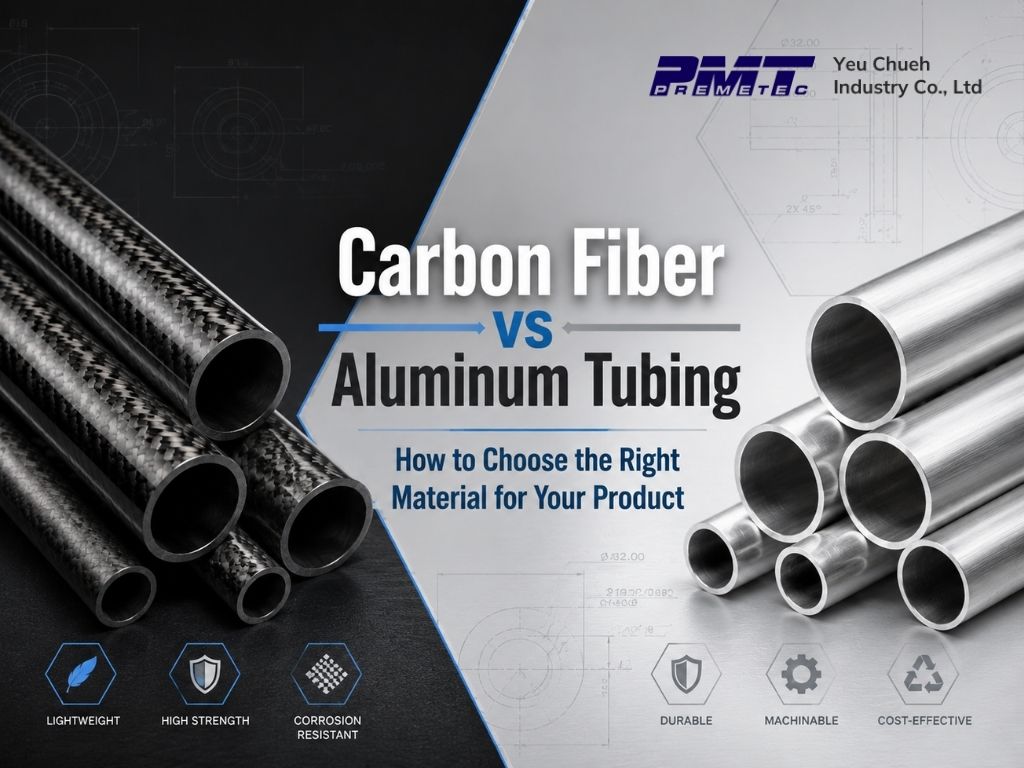
Choosing between carbon fiber and aluminum tubing is not simply a question of which material is lighter or stronger. The right choice depends on how the finished component will be loaded, manufactured, assembled, used, inspected, and produced at scale.
Carbon fiber is often preferred when maximum weight reduction, directional stiffness, vibration damping, and design freedom are priorities. Aluminum tubing is often the more practical choice when predictable material behavior, forming flexibility, dimensional control, production efficiency, and cost are important.
For products such as bicycle components, UAV structures, medical equipment, sports equipment, and other lightweight assemblies, engineers should compare the two materials at the component level rather than relying only on raw material specifications.
Table of Contents
- Carbon Fiber vs Aluminum: What Is the Fundamental Difference?
- Weight: Is Carbon Fiber Always Lighter?
- Strength and Stiffness
- Vibration and Ride or User Comfort
- Impact, Fatigue, and Long-Term Durability
- Manufacturing and Design Flexibility
- Cost and Production Considerations
- Carbon Fiber vs Aluminum Tubing Comparison
- Which Material Is Better for Different Applications?
- Can Carbon Fiber and Aluminum Be Used Together?
- How to Choose the Right Material for Your Product
- Choose the Material Based on the Finished Product
- Frequently Asked Questions
1. Carbon Fiber vs Aluminum: What Is the Fundamental Difference?
The biggest difference is not simply weight. The two materials behave very differently.
Aluminum alloy is a metallic material with relatively uniform properties in different directions. Once the alloy, temper, tube dimensions, and manufacturing process are defined, engineers can generally predict how the tube will respond to bending, forming, welding, machining, and structural loads.
Aluminum tubing can also be processed through methods such as tube drawing, butting, diameter reduction, CNC bending, hydroforming, heat treatment, machining, and surface finishing. This makes it highly adaptable to custom structural components.
Carbon fiber is a composite material. Its performance depends heavily on fiber direction, number of layers, lay-up sequence, resin system, tube geometry, and manufacturing method.
Instead of providing the same stiffness in every direction, carbon fiber allows engineers to place reinforcement where it is needed. This can be a major advantage, but it also means that carbon components must be engineered as complete structures rather than selected only according to a material grade.
2. Weight: Is Carbon Fiber Always Lighter?
Carbon fiber composites generally have a lower density than aluminum, giving them significant potential for lightweight structural design.
However, lower material density does not automatically mean every carbon component will be lighter.
Final component weight also depends on:
- Required safety factors
- Tube diameter and profile
- Wall or laminate thickness
- Joint design
- Inserts and mounting hardware
- Impact requirements
- Local reinforcement
- Manufacturing tolerances
An efficiently designed aluminum tube with variable wall thickness may therefore offer a highly competitive lightweight solution compared with a poorly optimized composite component.
Processes such as butting and hydroforming can retain additional material around highly loaded areas while reducing material in lower-stress sections. This allows aluminum structures to achieve a better balance between weight and structural performance without changing materials.
The correct question is therefore not:
“Which material is lighter?”
It is:
“Which material allows this specific component to meet its performance requirements at the lowest practical weight?”
3. Strength and Stiffness
Both aluminum and carbon fiber can provide excellent structural performance, but they achieve it differently.
Aluminum Tubing
High-strength aluminum alloys can provide a useful combination of strength, stiffness, formability, and low weight.
Aluminum also provides relatively predictable structural behavior, making it suitable for components where dimensional consistency, bending, joining, and repeatable mass production are important.
Tube diameter and profile can also have a major influence on stiffness. A carefully designed larger-section aluminum tube can achieve high structural rigidity without excessive material weight.
Carbon Fiber
Carbon fiber allows engineers to control stiffness through fiber orientation.
For example, additional fibers can be placed along the primary load direction to increase stiffness, while different orientations can be incorporated to manage torsion or other multidirectional loads.
This means carbon fiber can be engineered to provide high stiffness in selected areas without simply increasing material everywhere.
This characteristic is particularly valuable for products where weight distribution and directional stiffness must be tightly controlled.
4. Vibration and Ride or User Comfort
Vibration behavior can be just as important as strength.
Carbon fiber composites generally provide greater vibration damping than metallic aluminum structures. By adjusting the laminate design, engineers can further influence how vibration is transmitted through the component.
This can benefit applications such as:
- Bicycle handlebars
- Bicycle frames
- UAV arms and structures
- Wheelchair components
- Sports equipment
- Other user-contact structures
In bicycle applications, for example, carbon fiber can help reduce high-frequency road vibration before it reaches the rider. Aluminum generally transmits more direct mechanical feedback.
However, greater feedback is not necessarily a disadvantage in every application. Some structures prioritize immediate mechanical response, predictable rigidity, or direct steering feel.
Material choice should therefore reflect the desired behavior of the finished product rather than assuming that more damping is always better.
5. Impact, Fatigue, and Long-Term Durability
Durability cannot be judged from tensile strength alone.
Aluminum
Aluminum components may experience fatigue from repeated loading, particularly around:
- Welded areas
- Sharp geometric transitions
- Mounting holes
- Bends
- Thin-wall sections
- High-stress joints
Material grade, heat treatment, tube geometry, wall-thickness transitions, welding procedures, and manufacturing quality can all affect fatigue performance.
One practical characteristic of aluminum is that certain forms of impact damage may be visually apparent as bending, denting, or deformation.
Carbon Fiber
Carbon fiber can provide excellent fatigue performance when correctly engineered, but its damage mechanisms are different.
Severe impacts can cause:
- Fiber breakage
- Resin cracking
- Delamination
- Internal structural damage
Some composite damage may not be obvious from the external surface.
This is why carbon components require appropriate laminate design, local reinforcement, manufacturing control, and application-specific testing.
Neither material should simply be labeled as “more durable.” The relevant question is what type of load or damage the component is expected to encounter.
6. Manufacturing and Design Flexibility
This is one of the biggest differences for product developers.
Aluminum Tubing Manufacturing
Aluminum tubing can support a wide range of processes, including:
- Tube drawing
- Variable-wall or butted tubing
- Diameter reduction
- CNC bending
- Hydroforming
- End forming
- Machining
- Heat treatment
- Surface finishing
Hydroforming is particularly useful when conventional round tubing is insufficient. Internal pressure and tooling can create non-circular sections, expanded regions, ergonomic profiles, aerodynamic shapes, and other complex geometries.
This manufacturing flexibility makes aluminum suitable for customized lightweight structural applications where geometry, wall thickness, dimensional accuracy, and secondary processing must be considered together.
Carbon Fiber Manufacturing
Carbon fiber design relies more heavily on:
- Mold design
- Fiber orientation
- Lay-up sequence
- Resin selection
- Curing process
- Local reinforcement
- Inserts and interfaces
- Surface quality control
This provides exceptional design freedom, but changes to geometry or structural requirements can require significant modifications to tooling and lay-up design.
For this reason, manufacturing strategy should be considered during the product design stage rather than after the component geometry has been finalized.
7. Cost and Production Considerations
Carbon fiber usually involves higher material and processing costs, although the actual difference depends heavily on component complexity and production volume.
Carbon components may require:
- Dedicated molds
- More complex lay-up procedures
- Controlled curing
- Additional inspection
- More specialized labor
- Longer development cycles
Aluminum tubing can often offer a more economical route for prototypes, multiple product sizes, moderate production quantities, or components that require extensive bending and secondary processing.
However, cost should not be evaluated only as price per component.
A lighter carbon component may improve product performance enough to justify the additional cost in premium bicycles, UAVs, sporting equipment, or other performance-oriented applications.
Similarly, aluminum may provide better overall value when manufacturing flexibility, scalability, and cost control are more important than achieving the absolute minimum weight.
8. Carbon Fiber vs Aluminum Tubing Comparison
| Factor | Aluminum Tubing | Carbon Fiber |
|---|---|---|
| Weight Potential | Lightweight | Very high lightweight potential |
| Stiffness | Predictable and relatively uniform | Can be tailored by fiber orientation |
| Vibration Damping | Lower | Excellent |
| Impact Behavior | May dent or deform | May crack or delaminate |
| Fatigue Performance | Depends strongly on alloy, geometry, and joints | Excellent when properly designed |
| Shape Flexibility | Strong through bending and hydroforming | Very high with suitable mold design |
| Wall Optimization | Butting and variable-wall designs available | Local laminate reinforcement |
| Secondary Machining | Relatively straightforward | Requires careful composite machining |
| Prototype Flexibility | Generally high | Tooling can increase development effort |
| Production Cost | Usually more economical | Generally higher |
| Surface Options | Anodizing, coating, polishing, etc. | Molded or coated composite finish |
| Best Suited For | Balanced cost, strength, and manufacturability | Maximum lightweighting and tailored performance |
The table should be used as a starting point rather than a final material-selection rule. Actual performance depends on the complete component design, manufacturing process, loading conditions, and production requirements.
9. Which Material Is Better for Different Applications?
Bicycle Components
Both materials are widely applicable to bicycle components.
Aluminum is well suited to frames, handlebars, seat posts, and other components requiring structural performance, production flexibility, and cost control.
Carbon fiber is especially attractive for premium components where lower weight, tuned stiffness, aerodynamics, and vibration damping are priorities.
UAV Structures
Carbon fiber can be useful where flight time and payload capacity make every gram important.
Aluminum may be preferable for connectors, mounting structures, landing structures, formed sections, or components requiring precise mechanical interfaces.
A UAV may therefore use both materials rather than choosing only one.
Medical and Mobility Equipment
Aluminum offers an effective combination of low weight, durability, formability, and dimensional control for wheelchairs, walkers, rehabilitation equipment, and other mobility structures.
Carbon fiber can be considered for premium mobility products where further weight reduction and vibration behavior provide meaningful benefits to the user.
Sports and Outdoor Equipment
Aluminum is useful for structures that require forming flexibility, impact resistance, dimensional control, and manageable production costs.
Carbon fiber becomes attractive when low weight, directional stiffness, vibration characteristics, or premium performance are particularly important.
10. Can Carbon Fiber and Aluminum Be Used Together?
Yes. In many products, the best answer is not carbon fiber or aluminum, but a carefully designed combination of both.
A product might use carbon fiber for the primary lightweight structure and aluminum for:
- Mounting interfaces
- Inserts
- Clamps
- Connectors
- High-precision attachment points
- Formed secondary structures
However, one important engineering issue is galvanic corrosion.
Carbon fibers are electrically conductive. When carbon fiber and aluminum are placed in direct electrical contact in the presence of moisture or an electrolyte, galvanic interaction can accelerate corrosion of the aluminum.
Hybrid designs may therefore require appropriate electrical isolation, coatings, adhesives, interface materials, sealing, or other protection depending on the operating environment.
This consideration should be incorporated into the design from the beginning rather than handled only during final assembly.
11. How to Choose the Right Material for Your Product
Before selecting aluminum or carbon fiber, engineers and buyers should answer several questions.
What is the maximum acceptable component weight?
If every gram directly affects range, acceleration, portability, or athlete performance, carbon fiber may deserve stronger consideration.
What loads must the component withstand?
Consider bending, torsion, vibration, impact, fatigue, and localized loads rather than relying only on a single tensile-strength value.
Is directional stiffness important?
Carbon fiber offers greater ability to tune stiffness in specific directions, while aluminum generally provides more uniform material behavior.
How complex is the required geometry?
Both materials provide significant design freedom, but through different manufacturing processes. Hydroforming can create complex aluminum tube profiles, while composites can be molded into integrated shapes.
How will the component be assembled?
Welding, bonding, clamping, bolting, inserts, and mechanical interfaces can all influence material selection.
What production quantity is expected?
Tooling investment, labor, cycle time, design variation, and production volume may significantly affect the business case for each material.
What is the operating environment?
Temperature, moisture, corrosion, vibration, impact, outdoor exposure, and repeated use should all be considered.
What is the actual performance priority?
Instead of asking which material is simply “better,” define whether the priority is:
- Lowest possible weight
- Highest stiffness
- Vibration damping
- Impact tolerance
- Forming flexibility
- Production scalability
- Lower cost
- Premium appearance
- Dimensional consistency
Once these priorities are clearly defined, material selection becomes much more practical.
12. Choose the Material Based on the Finished Product
There is no universal winner in the carbon fiber vs aluminum tubing comparison.
Choose aluminum when you need a strong balance of lightweight performance, predictable structural behavior, forming flexibility, dimensional control, scalable manufacturing, and cost efficiency.
Consider carbon fiber when maximum weight reduction, tailored stiffness, vibration damping, or highly integrated structural design provides enough performance benefit to justify the additional development and manufacturing complexity.
In some products, combining the two materials can provide an even more effective solution by using each material where its characteristics create the greatest value.
The final decision should therefore be based on the complete product rather than one material specification. Structural loads, geometry, target weight, assembly method, operating environment, production quantity, manufacturing process, and cost should all be evaluated together.
Frequently Asked Questions
Is carbon fiber stronger than aluminum?
There is no universal answer because the two materials behave differently. Carbon fiber can provide very high strength and stiffness along selected fiber directions, while aluminum offers more predictable and relatively uniform material behavior.
The final performance depends on factors such as alloy or laminate design, component geometry, wall thickness, joints, load direction, and manufacturing quality.
Is aluminum better suited for mass production?
Aluminum tubing often provides advantages in production flexibility and cost control, particularly for products requiring bending, hydroforming, machining, multiple sizes, or ongoing design variations.
Carbon fiber can also be produced at scale, but tooling, lay-up design, curing processes, and inspection requirements may result in higher development and manufacturing costs.
The better choice depends on production volume, component complexity, performance targets, and acceptable cost.
Can an aluminum component be replaced directly with a carbon fiber version?
Usually not. A carbon fiber component should not simply copy the dimensions of an existing aluminum part because the two materials carry loads differently.
Fiber orientation, laminate thickness, joint design, inserts, mounting interfaces, impact requirements, and local reinforcement may all need to be redesigned.
Material substitution should therefore be treated as an engineering redesign rather than a one-to-one replacement.
Discuss Your Lightweight Structural Project with Yeu Chueh
Choosing between aluminum and carbon fiber should begin with the requirements of the finished product—not with the material alone.
Yeu Chueh Industry Co., Ltd. supports customers in evaluating aluminum alloy tubing, carbon fiber components, tube geometry, forming processes, structural requirements, and production feasibility for lightweight applications.
If you are developing a bicycle component, UAV structure, medical device, sports equipment, or other lightweight product, providing information such as drawings, target dimensions, load requirements, weight goals, expected production volume, and operating conditions can help establish a more suitable material and manufacturing approach.
Contact Yeu Chueh to discuss your project and determine which material and manufacturing solution best fits your product requirements.
