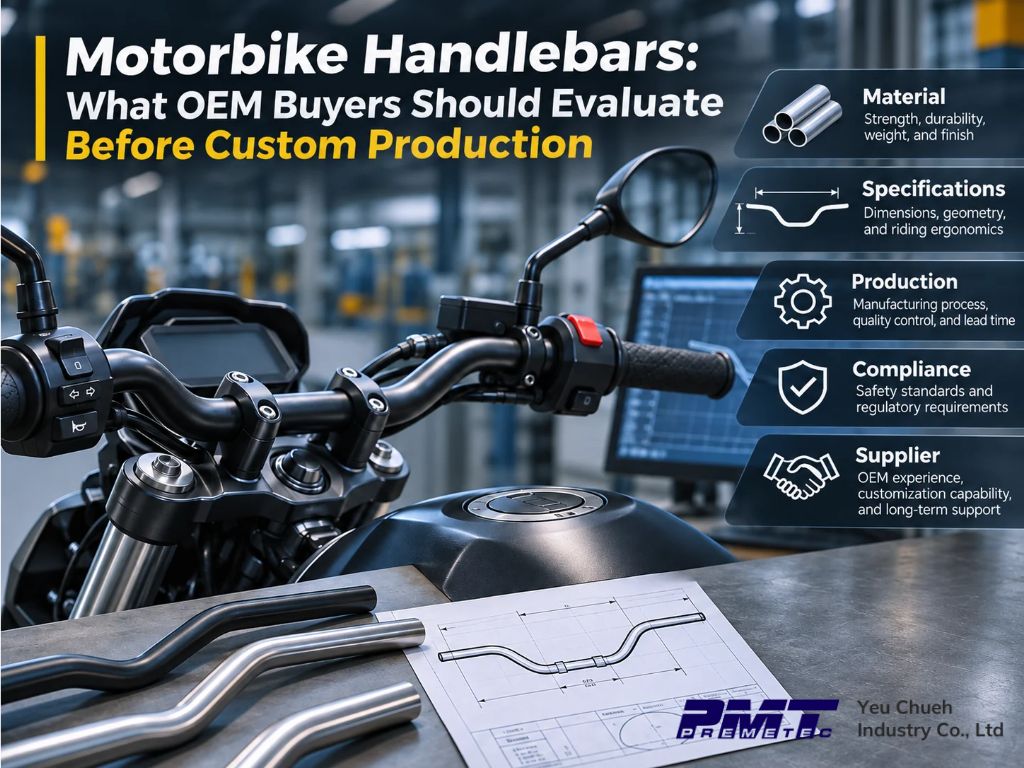
Custom motorbike handlebars require more than selecting a tube diameter and bending it into shape. For OEM projects, buyers need to evaluate material, wall thickness, bend geometry, clamp areas, grip interfaces, tolerances, fatigue, surface finishing, and validation requirements as one complete system.
The handlebar directly affects steering control, rider position, component mounting, vibration transmission, and the installation of grips, switches, levers, brackets, and other controls. If these requirements are not defined early, repeated prototype revisions can increase tooling cost, delay validation, and make mass production less predictable.
The following sections explain what OEM buyers should confirm before moving a custom motorbike handlebar from design into production.
Table of Contents
- What Should OEM Buyers Confirm Before Ordering Motorbike Handlebars?
- How Does Motorcycle Type Affect Handlebar Design?
- What Handlebar Diameter and Tube Dimensions Should Be Specified?
- How Should Material and Wall Thickness Be Selected?
- How Do Bend Geometry and Rider Position Affect Manufacturing?
- What Should Be Checked in the Handlebar Clamp Mount Area?
- How Should Grip and Control Interfaces Be Defined?
- How Do Vibration and Fatigue Affect Handlebar Design?
- What Manufacturing Processes Are Common for Custom Motorbike Handlebars?
- Which Tolerances Matter Most?
- What Surface Finishing Requirements Should Be Defined?
- What Should Be Verified During Prototype and Testing?
- What Information Should OEM Buyers Provide for Quotation?
- Frequently Asked Questions
1. What Should OEM Buyers Confirm Before Ordering Motorbike Handlebars?
Before requesting a quotation, OEM buyers should confirm the intended application, tube dimensions, material, bend geometry, clamp interface, grip area, performance requirements, finishing, and expected production volume.
The most important information usually includes:
- Motorcycle type
- Intended riding environment
- Handlebar diameter
- Wall thickness
- Overall width
- Rise and sweep
- Bend angles
- Clamp dimensions
- Grip area dimensions
- Mounting interfaces
- Required fatigue or durability performance
- Surface finishing
- Prototype quantity
- Expected annual production volume
A complete specification allows the manufacturer to evaluate both manufacturability and production risk before tooling begins.
Quick OEM Evaluation Summary
| Area | What Buyers Should Confirm |
|---|---|
| Application | Road, dirt bike, motocross, touring, or other platform |
| Tube | Diameter, wall thickness, material, tube profile |
| Geometry | Width, rise, sweep, bends, end positions |
| Clamp | Diameter, width, straight section, tolerance |
| Grip Area | Straight length, throttle side, control compatibility |
| Performance | Vibration, fatigue, impact, repeated loads |
| Processing | Bending, forming, drilling, machining, heat treatment |
| Finish | Surface treatment, color, cosmetic requirements |
| Validation | Prototype fit, dimensional inspection, durability testing |
| Production | Sample quantity, annual demand, project schedule |
2. How Does Motorcycle Type Affect Handlebar Design?
Motorcycle type affects handlebar geometry, load conditions, component layout, and structural requirements.
A handlebar designed for a road motorcycle may have very different requirements from one used on a dirt bike or motocross platform.
OEM buyers should first define:
- Road, dirt bike, motocross, touring, or other use
- Motorcycle weight
- Rider position
- Typical riding environment
- Expected vibration level
- Off-road impact exposure
- Installed controls and accessories
- Steering clearance
- Required durability or fatigue verification
For example, off-road handlebars may experience more frequent impact and vibration, while touring handlebars may place greater emphasis on rider position and long-duration comfort.
The application should therefore be defined before material, wall thickness, and bend geometry are finalized.
3. What Handlebar Diameter and Tube Dimensions Should Be Specified?
Handlebar diameter and tube dimensions affect structural performance, component compatibility, forming feasibility, and clamp installation.
OEM buyers should define more than just the nominal tube size.
Important dimensions include:
- Outside diameter
- Wall thickness
- Overall width
- Center section length
- Clamp section diameter
- Grip section dimensions
- Straight lengths
- Bend locations
- End geometry
One commonly searched specification is 7/8 dirt bike handlebars, but “7/8” alone is not enough to define an OEM component.
The center clamp area, grip area, throttle-side dimensions, bend geometry, and overall handlebar layout must still be specified.
A nominal tube size does not guarantee compatibility with the intended clamp, grips, switches, levers, or motorcycle assembly.
4. How Should Material and Wall Thickness Be Selected?
Material and wall thickness should be selected according to the complete handlebar design, not only based on the highest available material strength.
For aluminum motorbike handlebars, engineers should consider:
- Required mechanical properties
- Fatigue behavior
- Formability
- Bend requirements
- Heat-treatment requirements
- Target weight
- Surface finishing
- Production repeatability
Wall thickness also needs to be evaluated together with load distribution.
Using a thicker wall everywhere may increase strength, but it can also add unnecessary weight. Depending on the design and manufacturing method, material can be distributed according to the structural demands of different areas.
Higher-load areas may require more material, while lower-load regions may allow weight reduction.
Material grade, tube diameter, wall thickness, bend geometry, and processing method should therefore be evaluated together.
5. How Do Bend Geometry and Rider Position Affect Manufacturing?
Bend geometry determines both rider position and manufacturing difficulty.
OEM drawings should clearly define:
- Overall width
- Rise
- Sweep
- Bend angles
- Centerline radius
- Grip length
- Distance between bends
- Multi-plane rotation
- Final end positions
However, a geometry that works in CAD may still be difficult to manufacture consistently.
Manufacturing challenges can increase when the design includes:
- Tight bend radii
- Thin-wall tubing
- High-strength material
- Closely spaced bends
- Multiple bend planes
- Strict end-position requirements
Possible problems include flattening, ovality, wrinkling, thinning, springback, or dimensional variation.
Reviewing the bend design before tooling can often reduce these risks.
6. What Should Be Checked in the Handlebar Clamp Mount Area?
The handlebar clamp mount area must provide stable installation, correct positioning, and suitable load transfer between the handlebar and the motorcycle.
OEM buyers should define:
- Clamp diameter
- Clamp width
- Required straight section
- Center position
- Surface requirements
- Dimensional tolerance
- Relationship with the riser or upper clamp
- Positioning marks if required
The neighboring bends also need to be considered.
If a bend begins too close to the clamp area, there may not be enough straight length for stable installation or dimensional control.
Where a handlebar bracket, riser, or other mounting structure is used, the assembly relationship should be shown clearly in the drawing.
Critical mounting dimensions should be identified rather than applying excessively tight tolerances to the entire handlebar.
7. How Should Grip and Control Interfaces Be Defined?
Grip and control areas should be defined according to the components that will actually be installed on the handlebar.
Typical interfaces may include:
- Handlebar grips
- Throttle assemblies
- Brake levers
- Clutch levers
- Switch housings
- Hand guards
- Mirrors
- Bar-end components
Searches such as motocross handlebar grips usually refer to the grip component itself, not the metal handlebar. For an OEM handlebar project, the important issue is ensuring that the grip area is dimensionally compatible with the intended controls.
Buyers should specify:
- Straight grip length
- End diameter
- Throttle-side requirements
- Control mounting zones
- Hole locations
- Slot locations
- Bar-end geometry
- Insert requirements
- Clearance requirements
Secondary features such as holes or slots should also be reviewed together with the bend geometry.
A feature placed too close to a bend may be more difficult to machine or control consistently.
8. How Do Vibration and Fatigue Affect Handlebar Design?
Motorbike handlebars experience repeated dynamic loads, so fatigue and vibration should be evaluated in addition to static strength.
During actual use, handlebars may be exposed to:
- Steering input
- Engine vibration
- Road vibration
- Braking forces
- Rider input
- Repeated bending
- Off-road impact
- Accidental impact events
This means tensile strength alone is not enough to evaluate the component.
Fatigue performance is also influenced by:
- Bend locations
- Tube geometry
- Wall thickness
- Clamp areas
- Section transitions
- Drilled or machined features
- Surface condition
- Heat treatment
- Manufacturing consistency
Sharp transitions or poorly positioned secondary features can create local stress concentrations.
OEM buyers should therefore provide expected service conditions and required fatigue or durability criteria during the design stage.
9. What Manufacturing Processes Are Common for Custom Motorbike Handlebars?
Custom motorbike handlebars may require several manufacturing processes rather than only tube bending.
A typical production route may include:
Tube preparation → wall-thickness control → CNC bending → forming → trimming → drilling or machining → heat treatment → surface finishing → inspection
The actual sequence depends on the product.
Tube Preparation
The starting tube is selected or prepared according to diameter, wall thickness, material, and length.
Wall-Thickness Control
Some designs may require different material distribution in specific areas depending on structural requirements.
CNC Bending
CNC bending controls the handlebar geometry, bend angles, sweep, rise, and final position.
Secondary Forming
Additional forming may be required to create specific profiles or local geometry.
Drilling and Machining
Holes, slots, end features, and other interfaces can be added after the main forming process.
Heat Treatment
Depending on material and forming conditions, heat treatment may be required to achieve the intended final properties.
Surface Finishing
The final surface can be prepared according to appearance and functional requirements.
The manufacturing route should be determined from the finished component requirements rather than selecting individual processes independently.
10. Which Tolerances Matter Most?
The most important tolerances are those that directly affect assembly, steering geometry, control installation, and structural function.
Applying very tight tolerances to every dimension can unnecessarily increase:
- Tooling complexity
- Inspection time
- Scrap risk
- Production cost
OEM drawings should separate dimensions into three categories.
Critical Dimensions
These directly affect function, installation, or structural performance.
Examples include:
- Clamp diameter
- Clamp position
- End position
- Key bend angles
- Control mounting interfaces
Assembly Dimensions
These ensure correct fit with:
- Grips
- Levers
- Switches
- Brackets
- Risers
- Adjacent motorcycle parts
Reference Dimensions
These help describe the overall geometry but do not require the same level of manufacturing control.
For bent handlebars, additional tolerance requirements may include:
- End-position tolerance
- Angular tolerance
- Symmetry
- Twist
- Straight-section length
- Ovality
Clear tolerance priorities allow production and inspection effort to focus on the dimensions that matter most.
11. What Surface Finishing Requirements Should Be Defined?
Surface finishing should be considered during the design stage because cosmetic and functional areas may require different treatment.
OEM buyers should define:
- Required surface preparation
- Visible cosmetic areas
- Acceptable forming marks
- Acceptable tooling contact marks
- Machining appearance
- Color requirements
- Logo position
- Marking location
- Final surface-treatment specification
Clamp areas, grip areas, and decorative surfaces may have different acceptance criteria.
If appearance consistency is important, the buyer should provide visual references or measurable acceptance standards.
Defining these requirements before sample production helps avoid disagreement after finishing.
12. What Should Be Verified During Prototype and Testing?
Prototype evaluation should confirm fit, geometry, manufacturability, structural performance, and surface quality before volume production.
Dimensional Fit
Confirm that the handlebar fits:
- Clamp
- Grips
- Controls
- Levers
- Brackets
- Motorcycle assembly
Geometry
Verify:
- Width
- Rise
- Sweep
- Bend position
- Symmetry
- End position
Manufacturing Repeatability
The manufacturer should confirm whether the required shape and dimensions can be reproduced consistently.
Structural Performance
The prototype should be evaluated according to the project's required load, vibration, fatigue, or durability criteria.
Surface Quality
The finished sample should also confirm whether forming, machining, heat treatment, and finishing meet appearance requirements.
The goal of prototyping is not only to approve one sample. It is to confirm that the design can become a repeatable production process.
13. What Information Should OEM Buyers Provide for Quotation?
A complete quotation package helps the manufacturer evaluate tooling, process requirements, inspection, cost, and production feasibility more accurately.
| Category | Information to Provide |
|---|---|
| Application | Motorcycle type, riding environment, intended use |
| Design Files | 2D drawing, 3D CAD model, assembly drawing |
| Material | Preferred aluminum alloy and material condition |
| Tube | Diameter, wall thickness, material distribution |
| Geometry | Width, rise, sweep, bend angles, bend radii |
| Clamp Area | Clamp diameter, width, straight length, tolerance |
| Grip Area | Grip length, end geometry, throttle interface |
| Secondary Features | Holes, slots, inserts, trimming, machining |
| Performance | Vibration, fatigue, impact, load requirements |
| Surface | Finish, color, markings, cosmetic criteria |
| Inspection | Critical dimensions, test reports, acceptance standards |
| Volume | Prototype quantity and estimated annual demand |
| Schedule | Sample target and expected production timing |
If some specifications are still being developed, they should be clearly marked as open items.
Early communication allows the manufacturer to identify potential forming, assembly, or tooling issues before production investment begins.
14. Frequently Asked Questions
Are 7/8 dirt bike handlebars suitable for every dirt bike?
No. A nominal handlebar diameter alone does not determine compatibility.
The clamp system, grip interface, throttle assembly, controls, geometry, motorcycle layout, and required structural performance must also be evaluated.
For OEM development, buyers should provide the complete assembly requirements rather than only specifying “7/8 handlebars.”
What dimensions are most important for custom motorbike handlebars?
The most important dimensions usually include tube diameter, wall thickness, width, rise, sweep, bend angles, grip length, clamp dimensions, and final end positions.
Critical dimensions should be identified according to actual assembly and functional requirements.
Can an existing motorbike handlebar be copied for OEM production?
A physical sample can provide useful information about dimensions and geometry, but it does not provide the complete manufacturing specification.
Material, wall thickness, heat treatment, tolerances, performance requirements, finishing, and inspection criteria still need to be defined before production.
Related Articles
Tube Hydroforming Explained: How It Creates Lightweight, Complex Aluminum Tubing
Learn how internal pressure, tooling, material flow, wall thickness, and forming conditions are used to create lightweight aluminum tubing with complex profiles and integrated structural features.
What Buyers Should Know Before Ordering Custom Aluminum Alloy Tubing
Review the key information OEM buyers should prepare before custom tubing development, including material, dimensions, tolerances, forming requirements, inspection, and production volume.
Aluminum Alloy Tubing: Types, Properties, Manufacturing Processes, and Applications
Understand how aluminum alloy selection, wall thickness, forming processes, heat treatment, and end-use requirements influence custom aluminum tubing performance.
Develop Motorbike Handlebars for Stable OEM Production
A successful custom motorbike handlebar project requires more than reproducing a tube shape.
Material, wall thickness, bend geometry, clamp interfaces, grip areas, vibration, fatigue, manufacturing processes, tolerances, surface finishing, testing, and production repeatability should all be evaluated as one system.
For OEM buyers, involving the manufacturer before every specification is finalized can help identify forming or assembly risks earlier and reduce unnecessary prototype revisions.
When preparing a custom handlebar project, provide your 2D drawing, 3D model, tube specifications, clamp and grip interfaces, critical tolerances, performance requirements, prototype quantity, and expected production volume.
Contact Yeu Chueh to discuss the manufacturing feasibility of your custom motorbike handlebar project.
