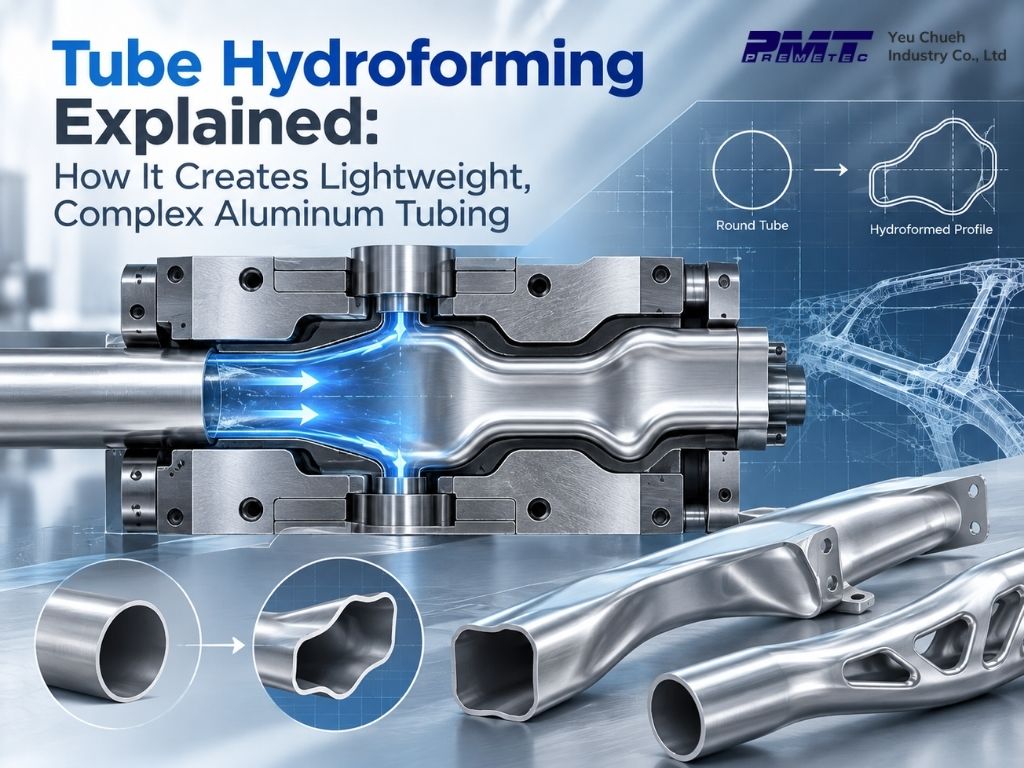
Tube hydroforming is widely used when conventional round tubing, bending, or secondary fabrication cannot efficiently achieve the geometry, weight, or structural performance required by a product.
Instead of simply bending a tube, tube hydroforming uses controlled internal fluid pressure—often combined with axial feeding—to expand a tubular blank against a closed die. This allows the tube to take on non-circular profiles, expanded sections, complex transitions, ergonomic shapes, and other geometries that would be difficult to produce with conventional forming alone.
For engineers developing bicycle components, motorcycle structures, medical equipment, UAVs, or other lightweight products, hydroforming can provide greater freedom to place material and shape the tube according to actual structural and packaging requirements.
However, hydroforming is not simply a matter of applying high pressure. Successful production depends on the correct relationship among material properties, starting tube geometry, wall thickness, tooling, lubrication, pressure, axial feeding, and heat treatment.
Table of Contents
- What Is Tube Hydroforming?
- How Does the Tube Hydroforming Process Work?
- How Does Hydroforming Create Complex Aluminum Tubing?
- How Does Tube Hydroforming Support Lightweight Design?
- Key Factors That Determine Hydroforming Success
- Common Tube Hydroforming Problems and Why They Occur
- Tube Hydroforming vs Conventional Bending and Fabrication
- Where Is Hydroformed Aluminum Tubing Used?
- When Should You Consider Tube Hydroforming?
- What Should OEM Buyers Provide Before Starting a Hydroforming Project?
- Frequently Asked Questions
1. What Is Tube Hydroforming?
Tube hydroforming is a metal-forming process in which a tubular blank is placed inside a closed die and shaped by internal fluid pressure.
In many applications, pressure alone is not enough. Axial punches at the ends of the tube can also feed additional material toward the forming zone while maintaining the seal. The combination of internal pressure and controlled axial feeding allows the tube material to expand and conform to the die cavity.
Unlike machining, hydroforming does not create the final profile by removing large amounts of material. Instead, it redistributes the existing tube material through plastic deformation.
The process can be used to create features such as:
- Non-circular tube sections
- Expanded or locally enlarged areas
- Tapered transitions
- Aerodynamic profiles
- Ergonomic shapes
- Complex three-dimensional forms
- Larger joint or assembly interfaces
- Integrated structural features
Yeu Chueh has applied hydroforming to products including frame tubes, handlebars, and seat posts, and its current aluminum tubing capabilities also include tube drawing, butting, diameter reduction, CNC bending, and secondary processing.
2. How Does the Tube Hydroforming Process Work?
Although the exact production sequence depends on the part, a typical tube hydroforming project involves several stages.
Step 1: Select and Prepare the Starting Tube
The process begins with the correct aluminum alloy, temper, diameter, wall thickness, and tube length.
The starting tube must provide enough formability for the required expansion while still meeting the final component's structural requirements.
Some components may also use variable-wall or butted tubing before hydroforming so that additional material is already positioned near high-load areas.
Step 2: Pre-Bending or Pre-Forming
If the finished component has a significant curve, the tube may first be CNC bent or pre-formed so it can fit properly inside the hydroforming die.
Hydroforming should not automatically be viewed as a replacement for bending. For many complex components, bending and hydroforming are complementary processes.
Step 3: Place the Tube Inside the Die
The prepared tube is positioned between matched die halves.
The die closes around the tube and defines the external geometry of the final component.
Step 4: Seal and Pressurize the Tube
The tube is filled with fluid and sealed at both ends.
Internal pressure is then increased in a controlled manner. Depending on the geometry, axial punches may simultaneously move inward to feed material into areas undergoing greater expansion.
The relationship between pressure and axial feed is critical. Too much pressure without sufficient material feed can promote excessive thinning or bursting, while excessive axial compression can contribute to wrinkling or buckling.
Step 5: Calibration
Near the end of the forming cycle, pressure can be increased to bring the tube into closer contact with detailed areas of the die.
This calibration stage helps establish the final profile and dimensional characteristics.
Step 6: Secondary Processing and Inspection
After forming, the part may require:
- End trimming
- Drilling
- Slotting
- Machining
- Welding
- Heat treatment
- Surface finishing
- Dimensional inspection
The entire manufacturing sequence should therefore be considered during the design stage rather than treating hydroforming as an isolated operation.
3. How Does Hydroforming Create Complex Aluminum Tubing?
One of the main advantages of tube hydroforming is that the final component does not need to retain the constant circular section of the original tube.
As pressure expands the tube into the die cavity, engineers can create different profiles along the length of the same component.
For example, one section could remain nearly round for a clamp interface, while another could transition into an oval or aerodynamic profile. A third area could expand to provide additional installation space or a larger structural interface.
This is particularly valuable when product designers need to accommodate:
- Batteries
- Motors
- Cables
- Sensors
- Mounting hardware
- Ergonomic grip areas
- Adjacent structural components
Yeu Chueh's bicycle applications, for example, use hydroforming to support customized aluminum frame and component geometries, while its motorcycle applications include hydroformed swingarm structures.
The benefit is therefore not simply a more unusual shape. Hydroforming allows geometry to become part of the structural and functional design of the tube.
4. How Does Tube Hydroforming Support Lightweight Design?
A common misconception is that hydroforming makes a component lightweight simply by making the wall thinner.
Effective lightweight design is more sophisticated.
The objective is to use the available material efficiently by combining:
- Tube profile
- Cross-sectional size
- Wall-thickness distribution
- Local reinforcement
- Structural geometry
- Load paths
A larger or more optimized tube section can sometimes provide greater stiffness without requiring a proportional increase in material.
Variable-wall tubing can also retain thicker material near joints or highly loaded regions while reducing wall thickness where less material is required. Hydroforming can then convert that optimized tube into the required external geometry.
Yeu Chueh currently uses this approach in lightweight applications such as bicycle and e-bike structures, where tube geometry and material distribution are considered together to balance rigidity, durability, and overall weight.
Hydroforming does not automatically make every component lighter. It gives engineers more freedom to create a geometry that uses material more efficiently.
The actual weight benefit depends on the complete component design.
5. Key Factors That Determine Hydroforming Success
Producing a good CAD model does not necessarily mean that the shape can be hydroformed successfully.
Several variables interact during the forming process.
Aluminum Alloy and Temper
Different aluminum alloys and tempers have different strength, ductility, and forming behavior.
A very high-strength alloy may provide excellent final mechanical properties but may require more careful process planning because available forming strain can be more limited.
Material selection should therefore consider both the finished component requirements and the forming process.
Starting Tube Geometry
Important variables include:
- Outside diameter
- Wall thickness
- Tube length
- Existing profile
- Wall-thickness distribution
These determine how much material is available for expansion.
Expansion Ratio
Large changes between the starting tube and final cross-section require greater material deformation.
If the required expansion exceeds the available formability of the tube, cracking or excessive thinning may occur.
Pressure and Axial Feeding
Internal pressure expands the tube, while axial feeding can supply additional material into the deformation zone.
These inputs need to be coordinated throughout the forming cycle rather than treated as independent settings.
Tooling Geometry
Tight corners, sudden cross-sectional changes, and deep expansions can increase forming difficulty.
The die must also withstand significant internal pressure while maintaining accurate alignment and closure.
Lubrication and Friction
Friction affects whether material can move from the tube ends toward the expansion area.
Excessive friction can restrict material flow and increase local thinning.
Heat Treatment
Depending on the aluminum alloy and starting temper, heat treatment may need to be coordinated with forming and later manufacturing operations to achieve the required final mechanical properties.
For this reason, alloy and temper, wall-thickness distribution, expansion ratio, tooling design, pressure control, material feeding, lubrication, and heat treatment should all be reviewed before a hydroforming project proceeds.
6. Common Tube Hydroforming Problems and Why They Occur
Hydroforming provides considerable design freedom, but the process also has clear forming limits.
Excessive Wall Thinning
When a section expands significantly, the tube wall can become thinner.
If material feeding and initial wall thickness are insufficient, local areas may become thinner than the design allows.
Bursting or Cracking
Excessive internal pressure or excessive local strain may cause the tube to fracture.
This can occur when the target geometry requires more expansion than the selected alloy, temper, or starting tube can accommodate.
Wrinkling or Buckling
If too much axial material is fed into an area before the tube is sufficiently supported by internal pressure and die contact, the tube may wrinkle.
Underfilling
Insufficient pressure or poor material flow can prevent the tube from completely filling corners or detailed sections of the die.
Tighter radii can be especially demanding because more pressure may be required to achieve full die contact.
Dimensional Variation
Even after the general shape is successfully formed, critical interfaces still need appropriate tolerance control.
Profile dimensions, end positions, twist, straightness, ovality, and assembly surfaces should therefore be identified before tooling development.
These risks explain why hydroforming feasibility should be evaluated before finalizing the product design.
7. Tube Hydroforming vs Conventional Bending and Fabrication
Tube hydroforming and CNC bending serve different purposes.
CNC Bending Is Well Suited For:
- Round or standard-profile tubes
- Controlled bends
- Multiple bend angles
- Relatively constant cross-sections
- Components where the tube profile does not need significant expansion
Tube Hydroforming Is Better Suited For:
- Non-circular cross-sections
- Changing profiles along the tube
- Expanded sections
- Integrated structural features
- Aerodynamic or ergonomic geometry
- Complex packaging requirements
Hydroforming may also help reduce the need to fabricate a structure from multiple separate pieces in some applications, because more geometry can potentially be incorporated into one formed tube. Whether this is achievable depends on the specific component.
The two processes are often used together.
Tube drawing → butting → CNC bending → hydroforming → trimming → machining → heat treatment → surface finishing
The ideal sequence depends on the product.
8. Where Is Hydroformed Aluminum Tubing Used?
Bicycle and E-Bike Components
Common applications include:
- Frame tubes
- Handlebars
- Seat posts
- Down tubes
- E-bike structures
Hydroforming is particularly useful where designers need lightweight structures, aerodynamic or ergonomic profiles, cable routing space, or integration around batteries and motors.
Motorcycle Components
Motorcycle components can be exposed to vibration, torsion, impact, and repeated road loads.
Hydroformed profiles can support applications such as swingarm structures where geometry, weight distribution, stiffness, and available installation space must be considered together.
Medical and Rehabilitation Equipment
Wheelchairs and other mobility products benefit from reducing structural weight while maintaining rigidity and durability.
Hydroformed aluminum tubing can also provide smoother or more ergonomic profiles where user interaction is important.
UAV and Lightweight Structural Products
UAV structures place a high priority on weight because structural mass can affect payload and operating range.
Hydroformed aluminum tubing can provide custom lightweight profiles for arms and other structures where stiffness, dimensional control, and component integration are important.
9. When Should You Consider Tube Hydroforming?
Hydroforming deserves consideration when your product requires one or more of the following:
- A tube profile that changes along its length
- Non-circular cross-sections
- Local expansion
- Complex three-dimensional geometry
- Weight reduction through more efficient structural geometry
- Additional space for internal components
- Ergonomic or aerodynamic tube profiles
- Integration of several geometric features into one tube
However, hydroforming is not automatically the best option for every tubular component.
For simple round tubes with straightforward bends, CNC bending and conventional secondary processing may provide a more economical solution.
The decision should therefore be based on geometry, structural performance, expected production volume, tooling investment, tolerance requirements, and total manufacturing cost rather than choosing hydroforming simply because the process is more advanced.
10. What Should OEM Buyers Provide Before Starting a Hydroforming Project?
The more complete the initial project information, the more accurately a manufacturer can evaluate hydroforming feasibility.
Buyers should ideally provide:
- 2D engineering drawings
- 3D CAD files
- Preferred aluminum alloy and temper
- Starting and final tube dimensions
- Required wall thickness
- Critical dimensional tolerances
- Structural load requirements
- Surface requirements
- Joining or welding requirements
- Critical assembly interfaces
- Expected prototype quantity
- Estimated annual production volume
- Testing or inspection requirements
For hydroformed components, it is especially important to identify which surfaces and dimensions are critical to assembly or performance.
The manufacturer can then evaluate whether the requested geometry is compatible with the alloy, available material flow, wall-thickness requirements, tooling, pressure path, and subsequent manufacturing processes.
Early manufacturing involvement can also reveal situations where a small design change significantly improves formability, reduces tooling complexity, or lowers production risk.
11. Frequently Asked Questions
Does hydroforming make aluminum tubing stronger?
Hydroforming primarily changes the tube geometry rather than automatically increasing the inherent strength of the aluminum alloy. However, a more efficient cross-section can improve the structural performance or stiffness of the finished component. Final performance still depends on material, temper, wall thickness, geometry, heat treatment, and load conditions.
Can hydroforming create variable wall thickness?
Hydroforming itself redistributes and stretches material during forming, so local wall thickness changes naturally occur. If a product requires intentional thicker and thinner zones, variable-wall or butted tubing can be prepared before hydroforming. The forming process must then be designed to control additional thinning during expansion.
Is hydroforming better than CNC bending?
Neither process is universally better. CNC bending is often more efficient for tubes with relatively constant cross-sections and conventional curves. Hydroforming becomes more valuable when the component requires expanded areas, changing profiles, non-circular sections, or integrated geometric features.
Related Articles
Aluminum Alloy Tubing: Types, Properties, Manufacturing Processes, and Applications
Learn how aluminum alloy series, wall thickness, temper, forming processes, heat treatment, and application requirements influence the performance of custom aluminum tubing.
What Buyers Should Know Before Ordering Custom Aluminum Alloy Tubing?
Review the key information OEM buyers should prepare before custom tubing development, including alloy, dimensions, tolerances, forming requirements, inspection, and production volume.
Carbon Fiber vs Aluminum Tubing: How to Choose the Right Material for Your Product
Compare aluminum tubing and carbon fiber in terms of weight, stiffness, vibration damping, durability, manufacturing flexibility, cost, and application requirements.
Turn Complex Tube Geometry into a Manufacturable Component
Tube hydroforming gives engineers greater freedom to move beyond conventional round tubing, but successful results depend on more than pressure and tooling.
Material selection, starting tube geometry, wall-thickness distribution, bending, expansion ratio, pressure and material feeding, heat treatment, dimensional tolerances, and downstream assembly all need to work as one manufacturing system.
Yeu Chueh has applied hydroforming technology to tubular components since 1997, including bicycle frame tubes, handlebars, and seat posts, and today combines hydroforming with aluminum tube drawing, butting, CNC bending, machining, and other precision processes for OEM/ODM development.
If you are developing a lightweight aluminum component with a complex profile, provide your 2D drawing, 3D model, alloy requirements, target wall thickness, critical dimensions, load conditions, and expected production volume for an early manufacturing evaluation.
Contact Yeu Chueh to discuss whether tube hydroforming is the right process for your product.
